Patient Corner » About Afib
|
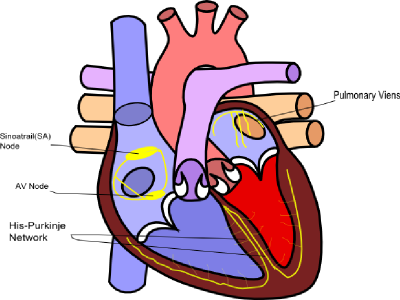
Atrial fibrillation (AF or Afib) is the most common irregular heart rhythm in the world; risk increases with age, with 8% of people over 80 having AF.. Atrial fibrillation (AF or afib) is a cardiac arrhythmia (abnormal heart rhythm) that originates in the two upper chambers (atria) of the heart. The electrical impulses that are generated by the internal pacemaker (sino atrial node) in the right upper chamber usually spread in a very organized fashion from the upper chambers to the lower allowing the synchronized activity. In patients with Afib, instead many impulses begin simultaneously and spread through the atria, overwhelming the sino atrial node, competing for a chance to travel through a junction box called AV node. This causes a rapid and disorganized heart beat not only resulting in the loss of synchrony between the upper and lower chambers, but also in rapid irregular heart beat with associated symptoms. Even though the upper chambers can beat up to 300 to 600 times per minute due to the inherent gate keeper properties of the AV node the lower chambers may beat any where from 120 to 240 times per minute. This may be continuous (persistent or permanent AF) or alternating between periods of a normal heart rhythm (paroxysmal AF). The natural tendency of AF is to become a chronic condition. Chronic AF leads to a small increase in the risk of death. |
Normal Conduction System
 |
Many people feel irregular heart beat and can often identify this arrhythmia by taking their pulse and observing that the heart beats dont occur at regular intervals, but a conclusive evidence will need an electrocardiogram (ECG). AFib is often asymptomatic, and is not in itself generally life-threatening, but may result in shortness of breath, fatigue, heaviness in the chest, palpitations, fainting, chest pain, or symptoms of congestive heart failure. Patients with AFib usually have a significantly increased risk of stroke, up to 3 - 6 times that of the general population depending on their risk factor profile. Stroke risk increases significantly during AFib due to the pooling of the blood in the poorly contracting atria, especially in the pouch like structure called left atrial appendage (LAA The level of increased risk of stroke depends on the number of additional risk factors.
AFib may be treated with medications which either slow the heart rate and/or revert the heart rhythm back to normal. Synchronized external electrical shock also called Direct Current Cardioversion (DCC) may also be used to convert AFib to a normal heart rhythm. Surgical and catheter-based therapies may also be used to prevent recurrence of AF in certain individuals. People with AF are often given anticoagulants
such as warfarin to protect them from stroke.